The Cantor’s Soup: A Lesson in Perspective
When my mother died in 2023—one month before her 93rd birthday—she left a legacy of stories. What began as a simple school project for my daughter blossomed into a lifelong effort by my mother to preserve her childhood memories.
The story below captures the earliest years of her life. As you read, look for those fleeting scenes that could be expanded into a vivid window into the Great Depression.
Do you have your own family recollections? Before you read my mother’s story, I encourage you to pause and reflect on a single scene from a relative’s childhood—one that feels small but lingers with clarity. As you read her account, notice how those brief, sensory moments become the “bones” of a narrative that can bridge generations.

The Way it Was
My earliest recollections happened before I was three years old. The wooden sidewalk that led from the house up through the gigantic yard to the large house on the next street was something that impressed me—mainly because of the splinters Daddy removed from my bottom when I fell.
I could remember Sunday mornings when we’d be up on the steps of that large house and would see the children crossing the street. I asked my mother where those children were going and she told me, “To Sunday School.” I replied, “When can I go to Sunday School, Mama?” She said, “When you are three years old.” It was with great pleasure that I went to Sunday School!
I was a Jewish girl and people probably don’t realize that Jewish children go to Sunday School too.
My two great-grandfathers, Wolf Weisfield and David Silverman, had come to this country from Lithuania along with their families at the time that the Cossacks were chopping off heads just for being Jewish.
They founded the Orthodox Jewish Synagogue in Easton, Pennsylvania.
My great grandfather, David Silverman, was the cantor.
I don’t know what business my Grandfather Silverman had in the “old country,” but when he came to Easton he thought, “What kind of business does this town need?” He decided that they needed a kosher butcher shop.
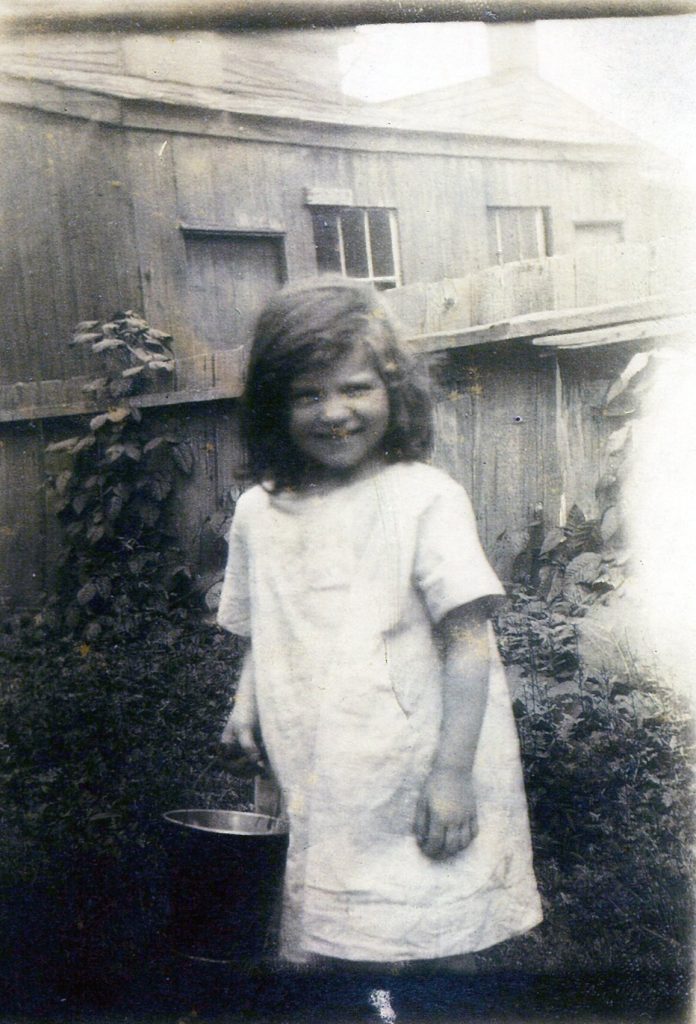
One day Grandfather invited us to dinner. I was a child of the 1930s and not as sophisticated as the children of today. I whispered to my mother “Mama, how does he get the food in his mouth?” Grandfather has a large, fuzzy beard.
When we left to go home, Grandfather gave Mama a lamb chop for me. This was a real treat. It was Depression times and we rarely had meat. There were times where we had no food at all.
My father had a good job when he and my mother were married in 1920, but then came the big crash and the business that daddy worked for went bankrupt.
For a period of time it was difficult for Daddy to find another job. My parents were too proud to tell their families that they were having a hard time. Daddy dug and planted a garden to help us with food. It was a lot of fun to watch Daddy spade the garden where he found many coins. I kept encouraging him to keep on digging.
One day when Daddy’s garden was doing well, a neighbor damaged it by putting his ladder in it in order to pick his cherries that were growing on our side of the fence. Daddy said, “I’ll fix him.” He made a contraption with a wooden codfish box, a poke, and a pulley. He went to the second story window and got some cherries for us.
We went to the store and I saw an orange object. I asked my mother what it was. She told me that it was an orange. I replied, “Do you think that some day when we get rich I can have one?”
One day when Grammy Silverman was visiting our home, my mother saw a mouse. She jumped up on the table and put her hands over her ears as she screamed. When my baby brother Bobby was born, my mother thought she had marked my brother. His one ear was a mass of soft fuzzy hair the color of the mouse. When he got older, the hair disappeared.
On another day when Grammy Silverman was visiting, Doctor Hummel came with his little black bag. He asked me, “Would you like a brother or a sister?” I thought for a while and I said, “A brother.” That’s how I got my brother Bobby. Grammy said the doctor had brought him in that little black bag. Now, what would I have done if I had asked for a sister?
Our friends, the Kalamanskis, lived in that large house at the end of the walk. We had initially lived in their apartment when my father was working; but when he couldn’t afford the rent because he didn’t have a job, they told us we could live in the little house at the other end of the wooden walk rent-free since no one else was renting it at the time. They were very kind people. I can remember visiting them and sitting on the bottom of the stairs that led from their kitchen. On the step was a can of cleanser with the Gold Dust Twins on it.
The little house had no central heating. There was a large iron stove in the basement. A coal bin was at one end of the basement, although I don’t remember any coal ever being in it. If there was, there wasn’t much as I remember going to the basement and lying on my stomach on a stuffed lounge that my father had built for me. I would face the opening of the coal bin.
One day when my mother came down looking for me, she asked me what I was doing and I told her that I was watching the mice play.
My mother went into the coal bin to get my brother’s baby bottle of milk. That is where she kept it to keep it cold. She was aghast when she came out, seeing a snail wrapped around it.
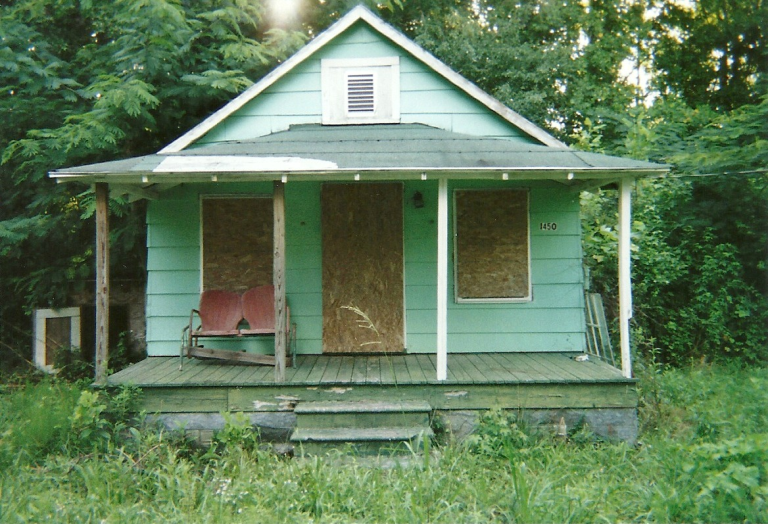
On the first floor there was a kitchen and a living room. On the second floor there were two bedrooms. Although my parents had a bed in one of the rooms for me, on cold winter nights they would put me in bed between them to keep me warm. Sometimes when we wanted to we would go to the basement and sit on a chair and put our feet in the oven to warm them.
Shortly after my brother Bobby was born, Daddy got a job and we moved to a second floor apartment in my Uncle Saul’s building. He owned a building that had two apartments, a store and a barber shop.
I remember the day we moved to our new home. Things had been carried into the dining room. The leaves to the dining room table were on the floor. I told my mother that I would be okay there by myself until they went back to the little house for some more furniture.
I found a few slices of raisin bread in a wrapper and I ate some. Then I lay down on the leaves to the dining room table and took a nap.
The apartment had a living room, a dining room, and a kitchen that were all large, two small bedrooms, a bathroom and an attic. Again, there was no central heating. There was a coal bin outside underneath the stairs that led to the entrance of the apartment. If we wanted hot water, we had to light the pilot light on the water heater in the bathroom.
A brown coal stove that looked like a piece of furniture was in the dining room to heat the apartment.
When it was very cold in the winter, we would put our clothes on the stove to get them warm before we put them on.
We were happy to live in the apartment and lived there until 1947 when Grammy Silverman was killed. Then we moved in with Uncle Herb at Grammy’s home so Uncle Herb wouldn’t be alone.
His house was really too crowded. My mother and father had a large front bedroom. Uncle Herb and both of my brothers shared the large middle bedroom. I slept in the bathroom which at times was quite convenient.
For Further Research: Building the Story
The “Clue” Technique
I haven’t been to Easton since I was seventeen-years-old to select a gown for my Junior Prom, so the first thing I did was to note the clues in my mother’s narrative and verify them as I would for any other author on one of my writing teams.
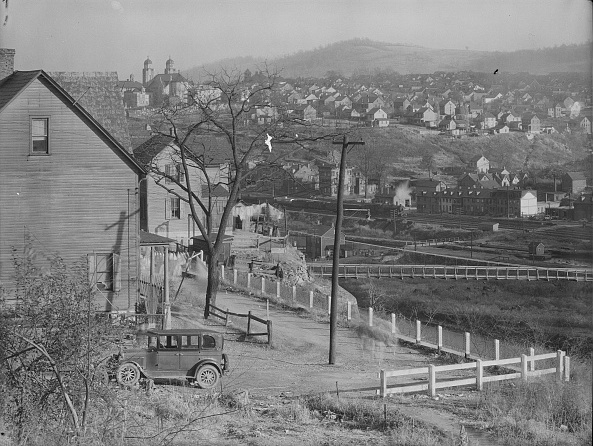
“Large House” vs. “Little House”: In the text, she mentions moving from the apartment in the Kalamanskis’ “large house” to the rent-free “little house.” By mapping the “clues”—from the splinters on the wooden walk at 663/665 Ferry Street to the cherry tree at 8 Sandts Court—we see that her world didn’t move blocks; it shifted mere yards to the back of the lot. This tiny geographic shift represents the massive economic shift of the Great Depression. It shows how families “contracted” their lives, staying on the same land while their circumstances changed completely. Even as her life moved forward, the geography remained tight: her move to 832 Walnut Avenue was only two blocks north, and her final move in 1947 to 54 South 9th Street was just three blocks east. By tracing these clues, we see that her entire upbringing was anchored within a three-block radius, illustrating how some families during the Depression survived by narrowing their world to the few streets they knew best.
The Researcher’s Toolkit: To verify the geography of this story, I relied on three primary “detective” tools. Sanborn Fire Insurance Maps provided the structural footprint of the neighborhood, allowing me to see the “wooden walk” and the exact location of the “little house” at 8 Sandts Court. City Directories acted as the era’s phone book, confirming that the Kalamanski family lived at 665 Ferry Street while my mother’s family occupied the rear. Finally, Federal Census Records provided the social context, documenting the ages, occupations, and relationships of everyone living on that lot. Together, these sources prove that while memories may soften over time, the documentary evidence remains to anchor the story in history.
The Cherry Tree Contraption: One of the most vivid scenes in the story involves my grandfather using a “wooden codfish box, a poke, and a pulley” to harvest cherries from a neighbor’s tree that overhung our yard. To a reader, this is a charming anecdote about resourcefulness; to a researcher, it is a spatial clue. By examining the Sanborn Fire Insurance Maps for 8 Sandts Court, we can see the tight property lines and the proximity of the neighboring structures. This spatial layout confirms how a tree on a neighboring lot could easily become a food source for a family in the rear house. It turns a tall tale into a documented reality of how one family creatively supplemented their larder during the leanest years of the 1930s.
Sensory Artifacts
The Gold Dust Twins: My mother vividly recalls sitting on the bottom of the kitchen stairs at the Kalamanskis’ house and seeing a can of cleanser with the “Gold Dust Twins” on it. To an author, this is more than a memory; it is a “time-stamp” artifact. This specific branding was ubiquitous in the 1930s, and its presence in the narrative anchors the scene precisely in the Depression era. When you are writing your own family history, look for these specific brand names or household items. They serve as sensory anchors that prove the timeframe of a story and help your readers see the exact kitchen or pantry where the history took place.
The Doctor’s Black Bag: My mother’s recollection of Dr. Hummel arriving with his “little black bag” is a classic example of a child’s perspective on a significant life event. While a child sees a magical vessel that “brings a brother,” an author sees a specific lead into local medical history. Dr. Hummel was a real practitioner in Easton, and his presence in the story provides a name that can be verified through professional registries and city directories of the 1930s. When you “put your author hat on,” you pay close attention to these professionals—doctors, midwives, or shopkeepers. These figures often left a distinct paper trail that allows an author to confirm exactly where a family was living and who they relied on during the most pivotal moments of their lives.
The Architecture of Recovery
The Move to Uncle Saul’s: My mother describes the transition to her Uncle Saul’s building as a significant upgrade, moving into an apartment with a formal dining room and a bathroom. While a researcher notes the new address, an author looks at the “brown coal stove that looked like a piece of furniture.” This detail is a narrative goldmine; it signifies the family’s shift from survival in a basement to a home where even the heating source had aesthetic value. An author looks for these descriptions of domestic life. The move from a basement coal bin to a second-floor apartment with a “pilot light” isn’t just a change of scenery—it’s the narrative arc of a family beginning to find their footing again.
From Facts to Footnotes
The Cantor and the Butcher Shop: While my mother remembered her grandfather’s kosher butcher shop as a cornerstone of her childhood, the Easton City Directory provided the archival evidence placing the shop at 23 South 6th Street. My research in Consider the Years (1944), by Joshua Trachtenberg, reveals a deeper spiritual legacy: her great-grandfather, Vulf (Wolf) Weisfeld, was among the first ten men (the minyan) who founded the community, while her other great-grandfather, David Silverman, served as the first Chazan-Shochet from 1888-1892. This means the family provided the very foundation of B’nai Abraham—the Orthodox Jewish Synagogue—handling both the spiritual liturgy and the community’s tangible need for kosher meat. Seeing that 6th Street address today anchors the memory of the “large, fuzzy beard” and that celebratory lamb chop in the actual geography of the 1930s.
The Final Layer: As an author, the goal of this process isn’t just to prove an address, it’s to provide the “bones” for a story that your family will actually want to read. By identifying the Kalamanski name, the “Gold Dust Twins,” and the three-block radius of her childhood, we’ve moved beyond a dry list of dates. We have reconstructed a world where the proximity of a neighbor’s tree or the warmth of a dining room stove tells the story of resilience. When you look at your own family records, don’t just ask “where?” and “when?” Ask “what could they see from their window?” and “how far did they have to walk?” Those are the answers that turn a researcher into an author.