Why “Show-Don’t-Tell” Is Not Enough: Unlocking the Power of Historical Interiority
When I returned to the formal study of creative writing in 2023, four decades after completing my undergraduate writing degree, I was struck by how much the landscape felt both intimately familiar and strikingly altered. The foundational principles of storytelling remained unchanged, but the vocabulary of the modern workshop had shifted. The most notable addition to the lexicon was the word “interiority.” My co-author on our historical narrative series on Forgotten Patriots of the American Revolution was unfamiliar with the term, and I realized I couldn’t blame her. During my initial studies, the word simply was not part of our literary jargon.
Chekhov’s Masterclass in Precision
Looking back, it is clear that we did not analyze a character’s inner life through the framework of craft; in fact, the elements of craft were completely lacking. Our education was grounded in pure literary analysis—the dissection of theme, motif, and plot structure—with very little, if any, focus on character development. In my short story course at UMass/Amherst, I remember my professor, Jay Neugeboren, who authored works like The Stolen Jew and Imagining Robert: My Brother, Madness, and Survival, emphasizing that writers of the short form must use words with absolute economy. To understand that economy, our models were Anton Chekhov, Franz Kafka, and Edgar Allan Poe. We recognized that in a short story, every single word must be a distilled, purposeful element, and we observed how these authors used that tight restraint to achieve a rich emotional depth. My favorite was Chekhov, who revolutionized the short story by focusing on hidden dialogues and purposeful details to reveal the tensions between the inner workings of the mind and the external responses of ordinary humans. For Chekhov, interiority is achieved through absolute precision and brilliant omission. Chekhov rarely handed us a character’s direct thoughts; instead, he built their inner world entirely through subtext—selecting a single, mundane external detail, like a cold plate of food or a ticking clock, to reveal a character’s profound loneliness or despair.
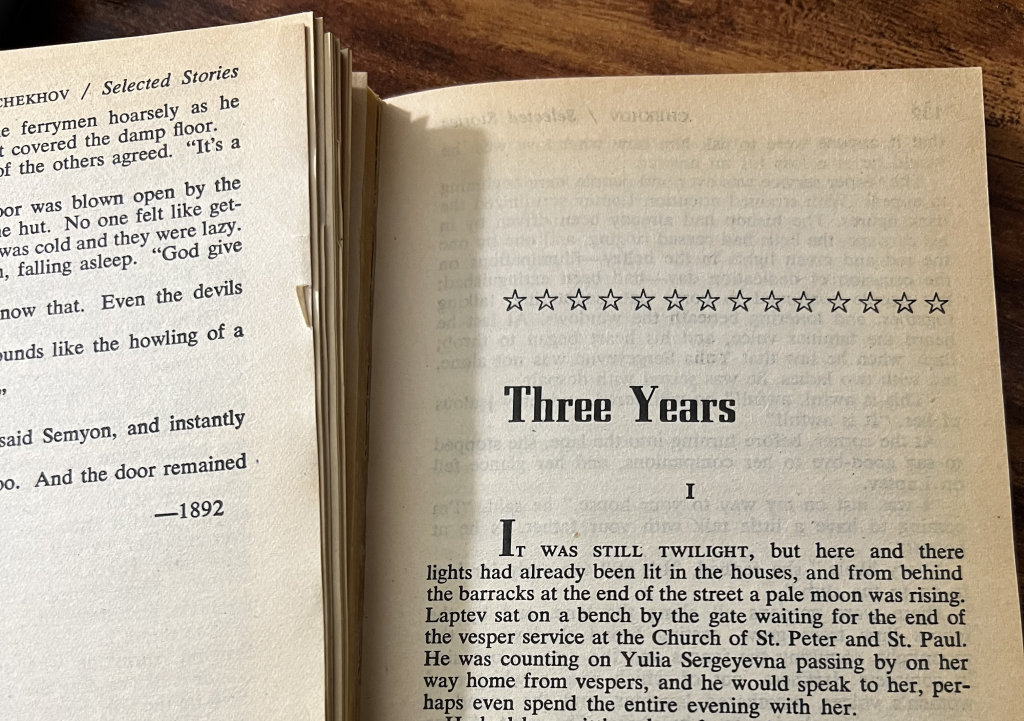
I recently pulled down from the top shelf of the bookcase a Signet Classic short story collection from that 1981 class. The pages were yellowed and the binding brittle with age. As I gently opened the book, the pages I had read those many years ago broke away from the binding and now lay flat as single sheets of paper. The last half of the book, which I had skipped over, remained intact. One of the greatest examples of psychological shift revealed through interiority can be found in an excerpt from one of the novellas.
In “Three Years,” Laptev is the son of a wealthy haberdasher living in an unnamed provincial town. In the evening moonlight, he sits on a bench by the gate, “counting on Yulia Sergeyevna passing by on her way home from vespers, and he would speak to her, perhaps even spend the entire evening with her.” But even then, as he waited for “an hour and a half,” his mind was distracted, thinking of a conversation in Moscow where he discussed how “passionate love is a psychosis, that there is no such love, but merely a physical attraction between the sexes …” and, “if anyone were to ask him now what love was, he would be at a loss for an answer.”
When Yulia finally appears, Chekhov describes the sensory trap and the physical reaction to hearing her familiar voice. Laptev’s brain was overwhelmed by the environment where young girls whispered and giggled and balalaika music played softly, which led to the physical response that his cynical theory about love being a “psychosis” or a temporary madness was completely correct. By September they were wed. Soon they realize that their reasons for desiring a life-long commitment were unequally yoked, for his was based on romantic infatuation and hers on a desire to escape her present situation. After three years, when she is delighted to see him after being apart for five days, he by contrast, feels “as though he had been married to her for ten years, and was longing for his lunch.” In his signature style, Chekhov guarded those moments of interiority, withholding direct access until moments of infatuation, yet capturing the entire transformation in one telling sentence. [Anton Chekhov, Selected Short Stories, translated by Ann Dunnigan (New York and Scarborough, Ontario: A Signet Classic, 1960), 134, 221.]
But this distillation of story could only be achieved after years of life experienced as a married woman with children who ultimately lost her youngest daughter to an accident and her husband to a pandemic. Forty years ago, we only analyzed these masterpieces as finished artifacts. We were never handed the tools to engineer that depth. We had to learn that for ourselves.
It was through Jay Neugeboren’s guidance outside of those lecture hours that I got my true start with novel writing. I was working on a piece deeply rooted in my family’s past, attempting to capture my maternal great-grandmother’s harrowing experience of migration from the pogroms in the Russian Empire (Lithuania) to Easton, Pennsylvania, where her father became one of the founders of an Ashkenazi Jewish community. Recognizing the historical and emotional weight of the project, Professor Neugeboren encouraged me tremendously, urging me to purchase Simon Dubnow’s two-volume collection, History of the Jews in Russia and Poland, to anchor my research.
Several years after I graduated, my mother transferred from editing the Journal of Social Issues to work as a secretary in the undergraduate English department (UMass/Amherst). Professor Neugeboren would periodically stop by her desk to ask how my writing was coming along with genuine concern. Back then, one of the greatest challenges that young writers faced was the lack of records needed to frame historical context beyond the fragments of oral history. We now know our family lived in Čekiškė, a tiny shtetl in the Kovno province of Lithuania. But even today, social history for that region is sorely lacking. While Dubnow’s volumes no longer hold a place in my personal library, and the demanding deadlines of non-fiction historical and genealogical narrative often preempt my focus, I have yet preserved the original note cards from that first novel draft. Accompanied by newfound evidence, they sit waiting—a quiet promise that I will one day return to them and finish the project.
Returning to the formal study of creative writing in 2023 finally bridged the gap between literary criticism and honing the craft. Today, we use a singular word to unify the disparate techniques I had spent decades analyzing: interiority. Coming back to the craft allowed me to see how this modern term crystallizes the exact methods of the masters, providing a vital tool for the current novel in development. In fiction, interiority is the invisible current that carries a story forward. Fundamentally, interiority is a character’s inner life—their secret thoughts, unvoiced feelings, buried memories, and intimate reactions to the world around them. It operates as the crucial literary space where the reader learns the absolute truth of a moment, bridging the canyon between a character saying “I’m fine” out loud and the terrifying knowledge that on the inside their fragile world is crumbling.
It helps to think of interiority as what the camera lens cannot capture. A purely cinematic approach to writing relies entirely on what can be observed. We see the visceral fight-or-flight responses to trauma, such as tightening corners of a mouth, furrowed brows, the ghostly pallor of sheer terror, or a face flushed with embarrassment. We hear the cadence and tone of their voice shifting unexpectedly, their nails nervously tapping, or when chattiness is suddenly replaced by utter silence. But these are external markers. True interiority highlights the painful friction between that public mask and the private truth.
Interiority as a Lens for Truth
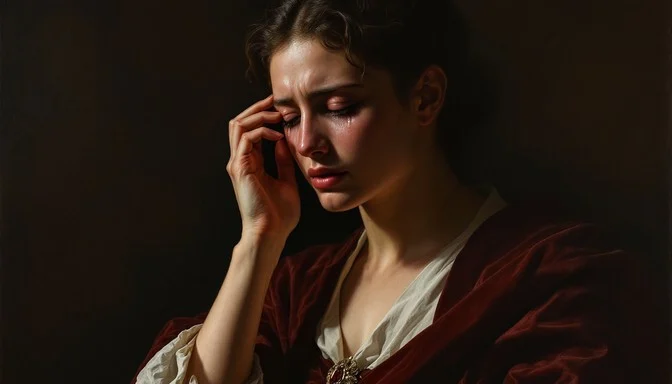
Consider a young woman who has just lost her child in a tragic accident. She enters a crowded room of long-time acquaintances, and as people greet her with pleasantries, she becomes aware that they are acting out of social obligation. The mother—aware of the disconnect between their words and their actions—offers a polite nod. Her guarded physical posture shields her from the emotional tension. Interiority, on the other hand, allows us to hear the desperate calculus of her inner voice as she tries to judge who among them cares enough to sit down and listen, and who might permit her to simply sob on their shoulder. It also exposes her internal reckoning when she has miscalculated.
When executed correctly, interiority has the power to extend further than the conflict between public performance and private pain. It contrasts the depth of a reaction against a typical response. Imagine that same young woman carrying heavy groceries while managing her surviving children, rushing to catch a bus. She arrives just as the doors slam shut and the bus pulls away, leaving her stranded on the curb. In an ordinary season of life, this is a minor, frustrating inconvenience. But how does that reaction deteriorate one week after the death of her youngest child? How does the same scene play out six months or a year later? What would that look like on the anniversary of the accident thirty years from now when her surviving children are grown adults? The internal timeline of grief dictates the intensity of her feelings and governs how she responds to her overtired, living children. Interiority pulls the reader directly into that specific mental process, building profound empathy for a reality they may have never personally experienced. However, achieving this depth in historical fiction requires moving beyond the surface of the past.
Rigorous Research: The Foundation of Historical Depth
For those who write historical fiction, crafting this inner life is not an exercise in pure invention; it is a discipline built on rigorous, multi-layered research. Because archival records often reduce historical figures to mere names and neglect to document the daily lives of women, authors must look elsewhere to reconstruct these psychological frameworks. This requires delving into historical psychology—studying period-specific diaries, letters, and sermons—to understand how individuals of the late 19th-century conceptualized grief, fear, honor, and duty, all heavily nuanced by the social expectations of their time. It also demands an investigation into material culture and sensory response—the suffocating stench of a decaying corpse masked by heavy perfume at a wake, the scratch of a stiff bombazine collar against a delicate neck, sounds of fidgeting children in a hushed parlor. Years later, memories of these events can trigger a character’s internal trauma response.
Ultimately, this form of creative empathy requires the author to conduct a profound type of introspection. Writers cannot evoke deep interiority in a historical subject without mining the depths of their own emotional history. To write authentic panic, profound joy, or shattering loss, we must access our own past traumas and triumphs. This process acts as an emotional mirror, and the intense creative immersion required to bring a character to life can unexpectedly trigger deeply buried emotional wounds within the writer. It is a vulnerable, heavy undertaking. Yet, it is precisely this willingness to risk personal emotional resonance that allows an author to transform a name on a page into a living, breathing human being whose private truths echo across the centuries.