

The Researcher’s Playbook for Personae Profiles
A Synthesis of Genealogy, Story Craft, and Psychology
Originally published as a multi-part series in September through October 2012 on the blog In Black and White: Cross-Cultural Genealogy; revised and expanded in 2026.
This framework first emerged in 2012, sparked by the intersection of Lynn Palermo’s Family History Writing Challenges and C.S. Lakin’s focus on the emotional “Heart of Your Story.” Over the last decade, I have evolved these roots into a unique methodology by layering in my background in psychology. By applying theories of birth order developed by Alfred Adler and expanded by Walter Toman, alongside the Myers-Briggs Type Indicator (MBTI), I’ve developed a new way to reverse-engineer distinctive personalities from archival fragments. When writing Historical Fiction based on a true story, we are responsible for the humanity behind the records. This playbook allows me to bridge the gap between the cold data and the living breath of a character, ensuring every personality is grounded in both historical fact and psychological science.
When I began writing family history, I realized that ancestors must become protagonists to truly live on the page. While genealogy is built on dates, memoirs are built on movement. For a story to grab a reader’s attention within the first few pages, we must move past the pedigree chart and introduce a character who is actively navigating their world. It is through their reactions in the midst of the action that we find the heart of history.
The Psychological Lense: Why Toman & Leman?
While genealogical records give us the who, when, and where, they rarely give us the why. To reconstruct the “Personae Profile,” I apply the Family Constellation theories of Walter Toman and the birth-order personality frameworks of Kevin Leman.
Specifically, I look at Toman’s Role Displacement: How a “youngest sister” (Nancy) reacts when she is suddenly forced into the “eldest sister” role of a new apprentice group. By merging these psychological “scouting reports” with primary source evidence, we move from static names to living, breathing stakeholders.
Reconstructing the Narrative Moment
Objective: To move from a static court record to a Personae Profile by identifying the tension between public legalities and private family stakes in order to write a courtroom scene where minor siblings are sent into court-ordered apprenticeship.
Every legal record (like an apprenticeship bond) represents a single, high-stakes day where multiple lives intersected.
This is to certify that we Kelsor Braddock and Sarah his wife wishes to have the following named children Bound out to Mr. William Temple 1. Isaac Carter [Corlee interlined], of the 13 year of his age; 2. Nancy [Carter], 10 years of age; 3. Annias [sic] Carter, of the age of 8 years; 4. Zachariah Carter, of the age of 5 years. This last named one has fits and is But a perish [sic] charge. We the above named Kelsor Braddock and his wife Sarah do certify that we are the Grand Father and Grand Mother of the above named Children and we should have come to court but for myself Kelsor am sick and have been for Twelve months so that neither of us can come to court. The Father & Mother of these children have both Deceased and the children is in a situation to suffer.
This transcription is reproduced from my research originally published in “Isaac Carter, Forgotten Patriot of Clubfoot and Cahooque Creeks, Craven County, North Carolina,” Journal of the Society of First Africans of English America, 2025. While the article focuses on historical legalities and kinship, this playbook explores how those records inform the emotional personae of the Carter family.
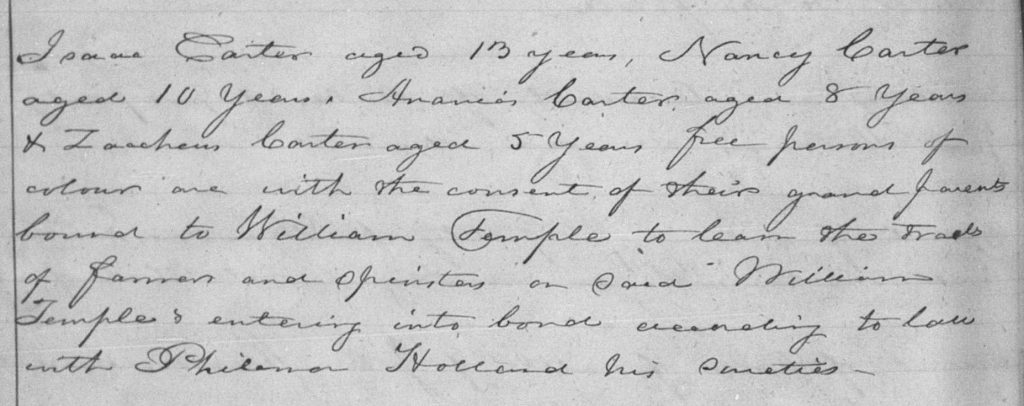
Isaac stands at the intersection of childhood and legal adulthood. In this scene, he isn’t just an orphan, he is a protector. Because he is the oldest sibling in the room (following his adult siblings Comfort, William, and Mary Ann), the birth order methodology suggests he would be acutely aware of the three younger children watching him. His “public persona” must be stoic for the Judge, but his “private self” is likely tethered to the 5-year-old Zach, tugging at his sleeve.
While the record gives us the facts, the Personae Profile gives us the truth: Isaac (14) wasn’t just being apprenticed; he was being promoted to the head of a family under the weight of 19th-century law.
| Role | Personae | Narrative Purpose |
|---|---|---|
| The Protagonist | Isaac Carter (14) | To pivot from child to “functional parent” under legal pressure. |
| The Protected Core | Nancy (10), Ananias (8), Zach (5) | To represent the family’s survival and the risk of permanent separation. |
| The Legal Foil | Judge Blackledge / Sheriff Chadwick / Clerk of Court J.G. Stanley | To represent the rigid social constraints of 1853. |
| The Witnesses | Courtroom Spectators | To provide the “Public Eye” and communal pressure. |
| The Strategic Guardians | Grandparents: Kelsor & Rhoda Braddock | To execute a preemptive legal strike to keep the “Core” together |
The Cast of 1853: A Psychological Profile of the Apprenticeship
Applying Birth Order and Family Constellation Theory to the Record, Reconstructed from the Craven County Court Minutes and the Original Apprenticeship Bonds.
In 2012, I began applying Alfred Adler’s foundational work on birth order (The Science of Living, 1929) to character development for historical fiction. To deepen this methodology, I integrate insights from Dr. Kevin Leman’s The Birth Order Book (Rev. ed. 2009) and Walter Toman’s Family Constellation (1961). These sources allow me to move past simple ages and look at the psychological roles and “family constellations” that shape an ancestor’s internal truth.
When we look at the Carter children in that New Bern courtroom, we aren’t just looking at ages; we are looking at family dynamics.
Isaac (14): The Functional First-Born
A reconstruction of the protagonist using the “Birth Order” methodology.
- The Core Need: Restoration of Order. He needs to believe that compliance and “being the man” can stabilize the family’s collapse.
- The Greatest Fear: Total Failure of Protection. The fear that the younger siblings will be scattered beyond his reach.
- The Persona Profile:
- Inward: A Squeezed Middle Child who feels the absence of his older brother and sisters as a physical weight; he is “negotiating” his own terror by focusing on the others.
- Outward: The Functional First-Born. He stands straight, uses formal language, and acts as a physical shield for Zach.
- The Adler Take: Power Displacement. Isaac adopts the “Eldest” traits of responsibility and perfectionism to compensate for the family’s collapse.
- The Toman Take: Rank Conflict. Biologically a junior, Isaac is used to having seniors buffer him. He is currently under “Role Strain,” performing a senior role he hasn’t “rehearsed.”
- The Leman Take: The Peacekeeper’s Burden. His drive isn’t natural leadership; it’s the middle-child’s need to “keep the peace” and minimize trauma for the group.
- The Playbook Application: Write Isaac as a character whose stoicism is a fragile mask. He isn’t leading out of confidence, but out of a middle-child’s desperate need for the “system” to stop hurting.
The Protected Core (The Stakeholders): In a Personae Profile, these children provide the emotional bridge. They are old enough to remember their parents, but young enough to be molded by the new master, William Temple. Their core need is a sense of belonging in a shifting world; they are the high stakes that Isaac is fighting to keep intact.
The siblings’ futures are the primary stakes of the court scene, intensified by the underlying threat of Zach’s medical condition.
Nancy (10): The Sibling Pivot (Displaced)
- The Core Need: Relational Attachment. She needs a “Senior Female” to mirror; in its absence, she attempts to become that anchor.
- The Greatest Fear: Emotional Erasure. Being treated as a “utility” (an apprentice) rather than a person with a family identity.
- The Persona Profile:
- Inward: A Middle Child who has lost her buffers; she is hyper-vigilant, scanning the Legal Foil for signs of danger.
- Outward: The Functional Matriarch. She mimics her absent mother’s gestures—smoothing Zach’s hair or adjusting Ananias’ collar.
- The Adler Take: Role Assumption. Nancy is “racing” to fill a vacant role. Her caregiver status is a compensation for her own feelings of powerlessness.
- The Toman Take: Complementary Collapse. As a “younger sister of sisters,” she has lost the female hierarchy that defined her. She is now the only girl, forced into a senior gender role.
- The Leman Take: The Squeezed Mediator. She is the “emotional glue” of the trio, but because she is “squeezed” between the older Isaac and younger boys, she has no one to provide that glue for her.
- The Playbook Application: Use Nancy to represent the “Environmental Tension.” Her hyper-vigilance allows the reader to see the courtroom through her eyes as she “reads” the threats the boys might miss.
Ananias (8): The Sibling Pivot (Stable)
- The Core Need: Structural Continuity. He needs the “system” of his siblings to remain intact so he knows where he fits.
- The Greatest Fear: The Unknown Variable. He fears the “Master” and the “Boatman”—strangers who represent an unpredictable, new system.
- The Persona Profile:
- Inward: The Analytical Observer. He is calculating the distance between the courtroom and the lodging house.
- Outward: The Compliant Anchor. He follows Isaac’s lead perfectly, providing the “Rank Duplication” that keeps the group looking like a unit.
- The Adler Take: Social Interest. Ananias is the most “socially balanced” of the group, focusing on the group’s unity rather than his own individual plight.
- The Toman Take: Rank Duplication. Because his position (younger than Isaac, older than Zach) is preserved in the group of three, he is the most “stable” character psychologically.
- The Leman Take: The Independent Middle. Since his rank is stable, he has the mental bandwidth to be the “camera,” noticing details the others are too stressed to see
- The Playbook Application: Ananias is your “Witness.” Use his perspective to describe the Physical Frame—the smells, the dust, and the spectators—because he isn’t under Role Strain. Because of this, when writing in third person limited point-of-view, the writer would select Ananias as the POV character. He holds the keys to the events of the day. But more than that, the eight-year-old boy is old enough to understand the physical reality of leaving the grandparents’ home but young enough to still be fascinated by the mechanics of the journey. His character is able to carry the weight of the chapter from the beginning of their disrupted family circle to the conclusion of being assigned to a new environment.
Zach (5): The Endangered Youngest
- The Core Need: Biological Regulation. Proximity to caregivers to prevent his biological constraint (the seizures) from escalating.
- The Greatest Fear: Sensory Overload of Abandonment. The fear that the “Legal Foil” will separate him from those who know how to help him when he’s sick.
- The Persona Profile:
- Inward: A Showman whose stage is being demolished; he is in a state of high-arousal distress.
- Outward: The Disruptor. His “fits” are a physiological protest—a way of using his body to halt the legal proceedings.
- The Adler Take: The Speed of the Group. Zach dictates the pace. His seizures operate as a systemic collapse that instantly freezes the legal proceedings and forces the court to confront his physical humanity.
- The Toman Take: Complementary Pair Loss. His identity is built on being the “receiver” of care from multiple seniors. With the Strategic Guardians gone, he is in “Survival Mode.”
- The Leman Take: The Attention-Seeker. Attention equals safety. If the court ignores his humanity, his brain/body will force them to pay attention through a medical crisis.
- The Playbook Application: Treat Zach as the “Closing Door.” Use the fact that there are no further records of him to imbue his presence in this scene with a tragic, prophetic finality.
The Legal Foil (The Constraints)
- Judge William Blackledge: Justice of the Peace. The final arbiter of the children’s fate. He represents the ultimate authority that Isaac must satisfy with his miniature man persona.
- Samuel W. Chadwick: Sheriff. The physical presence of the law in the room. He is the visual reminder that any failure to comply has immediate, physical consequences.
- J. G. Stanly: Clerk of Court. The man whose pen makes the event permanent. He is the bridge between the lived moment and the static record you are now deconstructing.
The Witnesses (The Social Fabric)
- William Temple: The Master. A family friend stepping into a paternal role. His high social standing as a major landowner and the eventual donor of the Methodist Episcopal Church land provides the moral collateral needed to satisfy the court.
- Stephen Priestly: Boatman. The literal link between the children’s past and their new home. As a witness, he provides the continuity and community oversight that ensures the transfer of guardianship is honored.
- Courtroom Spectators & Lodging Guests: The “Public Eye” that underscores the shift in the family’s social standing. Their presence turns a private tragedy into a public transition of power.
The Strategic Guardians: Kelsor & Rhoda Braddock
The Absent Heart of the Apprenticeship.
- Core Need: Legacy Continuity. To ensure their grandchildren have a trade and a roof before they (the grandparents) pass away.
- Greatest Fear: Involuntary Separation. They fear that their own physical decline will leave the children at the mercy of a court that might scatter them to unknown masters.
- The Personae Profile:
- Inward Persona: The Grieving Architects. They are physically broken by age and illness but mentally sharp, navigating the law to secure a safety net they won’t live to see.
- Outward Persona: The Strategic Petitioners. Even from their sickbed, they project an image of responsible, community-minded elders who are proactive in providing for the children’s welfare.
The Family Constellation Table
| Child | Birth Year | The Gap | Mother’s Age | Father’s Age |
|---|---|---|---|---|
| Comfort | 1832 | — | 16 | 27 |
| William | 1834 | 2 years | 18 | 29 |
| Mary Ann | 1838 | 4 years | 22 | 33 |
| Isaac | 1840 | 2 years | 24 | 35 |
| Nancy | 1843 | 3 years | 27 | 38 |
| Ananias | 1845 | 2 years | 29 | 40 |
| Zach | 1848 | 3 years | 32 | 43 |
Note: Birth years provided in this table are based on an additional birthdate list provided elsewhere in the 1853 Bond file; the parents’ ages are calculated by census data, in some instances representing an approximation.
The Personae Profile Methodology
A universal framework for reclaiming the human story from the quiet records of the past.
Step 1: The Evidence Anchor

An Anchor is any primary record that proves a presence; it is the non-negotiable pulse that starts the story.
- The Action: Identify the Fixed Variable—the specific record that proves a person existed in a certain time and place (e.g., family Bibles, land deeds, letters and diaries, an heirloom family group portrait, court records).
- The Goal: To establish the Truth of the Moment upon which the rest of the scene is built.
Step 2: The Environmental Architecture

Architecture defines the friction; it maps the external pressures forcing a family to pivot.
- The Action: Identify the biological, social, or geographic Pressures acting on the household (e.g., brothers going to war, death in the family, birth of a child, neighbor disputes over land, a failing family economy, an aging elder coming to live with the family, family disintegration upon the death of the patriarch/matriarch).
- The Goal: To define the Obstacle—the specific reality that makes the status quo impossible to maintain.
Step 3: The Psychological Synthesis

Synthesis maps the internal shift; it tracks how the family organism rewrites its own roles.
- The Action: Apply the Adler/Toman/Leman frameworks to map how the group realigns when a member is added, removed, or repositioned.
- The Goal: To identify the Sibling Pivot—the person whose life path or responsibilities are most dramatically altered by the new family dynamic.
Step 4: The Narrative Reconstruction

Reconstruction is the synthesis; it weaves the hard records with the psychological stakes.
- The Action: Combine the data from Step 1 with the mapping from Step 3, focusing on the Absent Heart—how the person who is missing dictates the behavior of those who remain.
- The Goal: To produce a scene that remains historically grounded and authentic to the record while capturing the deep, lived experience of the family.
Step 5: The Final Archival Stop

The vanishing trail is not a dead end; it is the final documented moment of a life.
- The Action: When the records stop abruptly, treat that silence as a Finality Metric rather than a research failure.
- The Goal: To imbue the “end of the trail” with Prophetic Weight, ensuring the subject’s last known moment is written with the significance it deserves.