Finding Abraham Hyman, Sr.: The Silence of the Ledger
Originally published as a two-part series, “The Will of Thomas Hyman,” in July 2015 on the blog In Black and White: Cross-Cultural Genealogy; revised and expanded in 2026.
In 2015, I was deeply immersed in a period of intentional skill-building, specifically researching Abraham Hyman, Sr. My goal was clear: I was preparing to “go on the clock” to assemble my portfolio for the Board for Certification of Genealogists (BCG).
In the genealogical community, completing a BCG portfolio is widely considered the equivalent of writing a Master’s Thesis. It is a monumental, multi-year undertaking that culminates in requirements like Section 4 (a full client research report), Section 5 (a complex case study), and the infamous Section 6—the Kinship-Determination Project, which demands a multi-generational narrative genealogy built on the highest standards of proof.
Despite my efforts, I never completed my certification with the Board for Certification of Genealogists. Throughout the process, my portfolio mentor, Elizabeth Shown Mills, would often respond to my questions with, “I can’t tell you that, but I can tell you this.” It was her way of nudging me to think critically and find my own answers. Last year, she shared a piece of advice I still carry: “It’s never too late.” She’s right. The door never truly closes. I still have shelves of research—six years of documentation on the family of John King of Hartford and Northampton—waiting for a new kinship project to emerge.
Looking back at 2015, I am reminded that every meaningful genealogical endeavor begins in the same place: a return to the fundamentals. That realization brings me back to Section 3, the documented work requirement.
The BCG application guide describes this “mystery document” exercise. Candidates receive a historical record drawn from their chosen place and time, often one that reflects the imperfections we know so well—faded ink, difficult handwriting, or missing citations. From this single document, five distinct pieces must emerge: a transcription, an abstract, a research question, an analysis, and a research plan. It is both humbling and exacting work, requiring patience, discipline, and a willingness to sit with uncertainty.
As I prepared, I decided to create my own version of the exercise. Rather than choosing an unfamiliar record, I turned to one that carried both personal weight and historical significance: the 1807 will of Thomas Hyman of Craven County, North Carolina.
Why Thomas Hyman’s Will: The Power of Probate
Selecting a last will and testament for this level of analysis was intentional. In genealogical research, probate records are among the most revealing sources available because they move beyond the simple enumeration of census schedules and tax lists. Instead, they capture relationship, intent, and community structure, identifying heirs and clarifying kinship networks that are often only implied in other records. In this way, probate documents serve as both legal instruments and narrative frameworks for reconstructing families.
In the context of African American genealogy, their importance is even more pronounced. Prior to 1870, enslaved individuals were rarely recorded by name in federal records. Probate documents—especially wills and estate inventories—are among the few sources where enslaved people may be identified individually. These records, though created within a system of exploitation, now serve as critical entry points for reconstructing families and tracing lineage.
Thomas Hyman’s 1807 will of Craven County, North Carolina, offers a clear example of this evidentiary power. Documents of this type can:
- Identify individuals otherwise absent from the historical record, providing names where only numbers once existed.
- Reveal patterns of forced migration by showing how enslaved individuals were distributed among heirs.
- Illuminate family and community structures through groupings, bequests, and associations.
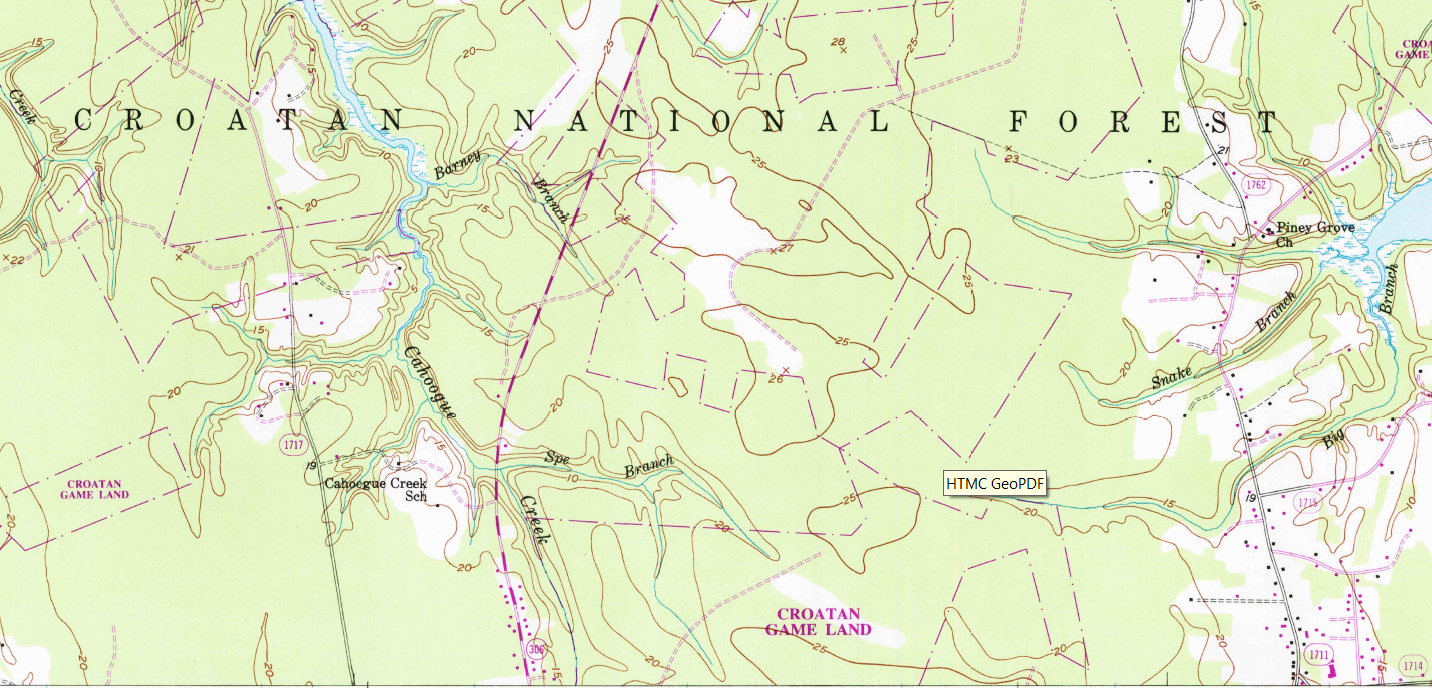
- Anchor individuals to place through references to geographic features such as Cahooque Creek and surrounding communities.
For analytical purposes, a will like Hyman’s is not simply a record—it is a layered source that demands careful, methodical examination. Each name, phrase, and provision has the potential to contribute to a broader reconstruction of people, relationships, and movement over time.
In my 2015 exercise, I approached this document as both a rigorous analytical test and a foundational source. The goal was to extract every possible clue—textual, contextual, and relational—without assumption or oversight.
Here is how that analysis began:
Transcription of the Will
The first step in analyzing any historical document is creating a transcription. This process requires rendering the text exactly as written, preserving the original spelling, punctuation, capitalization, and line structure. No interpretation or correction is introduced at this stage; the goal is accuracy, not clarity.
In working with Thomas Hyman’s 1807 will, I followed a strict line-by-line approach, maintaining the document’s original format while carefully noting legibility challenges such as faded ink and irregular handwriting. Any uncertain readings are indicated using standard transcription conventions.

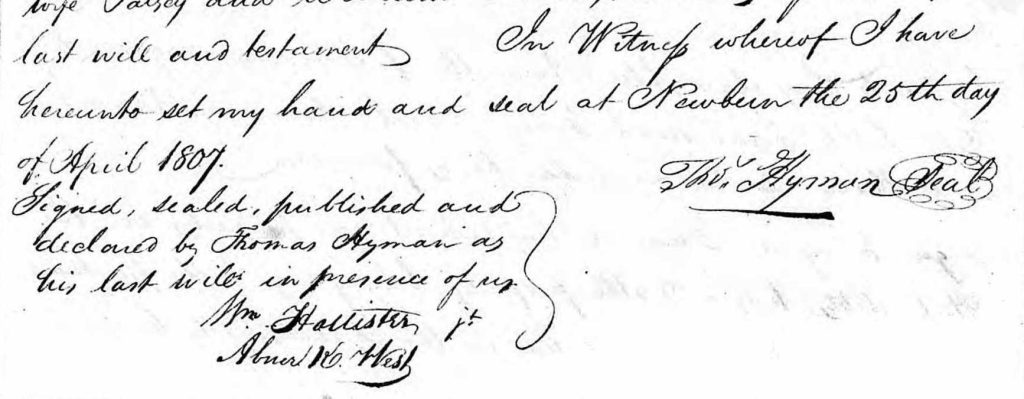
Craven County, North Carolina, Wills 1708-1970, Will Book B, folios 287 & 288, original will of Thomas Hyman, 25 April 1807, record ID CR. 028.81.23; State Archives of North Carolina, Raleigh.
In the name of God Amen, I Thomas Hyman of the
County of Craven being of sound disposing mind and memory
do make this my last will and testament.
I give my dear wife Patsey, during her life, one third part of
all my lands including the building where we reside.
I give my said wife the following negroes, viz. Stepney, Dinah,
big Tom, Molly, Sam, Fielder, Cambridge, Charity, Rachael,
and blacksmith Godfrey to her and her heirs forever.
I give to my son Samuel, all that part of my lands situate
in Craven County upon Hancocks Creek, which lies to the
Northward of Bounder neck gut and the South prong of said
gut, to him, his heirs, and assigns forever.
I give to my daughter Ann, all that part of my lands situate
in Craven County upon Hancocks Creek, which lies to the
Southward of Bounder neck gut, and Southward of the South
prong of said gut: to her, her heirs and assigns forever.
I give to my son Samuel the following negroes, Viz.
Nelly, Affrica, Bob, Ben, big Bill, Abraham, Sukey,—
little Bill, David, and my half of negro Larry, owned
by William Conway and me, to my said son his heirs
forever.
I give to my daughter Ann, the following negroes, Viz
Till, Little Tom, Noah, Tobey, Jacob, America, Adam,
and Hett, to her and her heirs forever.
I give to my son Samuel my interest and property in the
Stock, debts, tools and other property belonging to the partnership
of William Conway and me in the Blacksmithy business,
excepting only my interest in the negroes Willougby and
Phobe, which I give to the said William Conway.
The residue of my estate I give to be equally divided among
my wife and two children.
In case either of my children should die under the age of
twenty one years, and without issue living at their decease,
it is my will, and I do devise that the shares of such child
in my estate under any clause of the will, go to and vest in
the surviving child. And in case both my children
should die under the age of twenty one years, and without
issue living at the time of their decease, Then I give and
devise to Betsey Coart, daughter of my former wife, all the
negroes which I obtained by my marriage with her mother
and the residue of the negroes & personal property given to my
children, & the profits arising from the same, which shall not
have been applied for and towards the maintenance and
education of my said children. I give upon the death of my
children, as aforesaid, to my wife, & her heirs forever.—
My lands, upon the death of my children as foresaid
I give to my nephew William Conway, to him & his
heirs forever. I nominate and appoint my
wife Patsey and William Conway, Executors of this my
last will and testament. In Witness whereof I have
hereunto set my hand and seal at Newbern the 25th day
of April 1807.Signed, sealed, published and
Declared by Thomas Hyman as
his last will in presence of us
Wm Hollister, J[ura]t
Abner K West)
)
)
)
)Thos Hyman (Seal)
State of North Carolina
Craven CountyCourt of Pleas & Quarter
Sessions December Term 1807
The foregoing last Will and Testament of Thomas Hyman
deceased was produced and the due execution thereof by
the testator was proved by the oath of William Hollister
one of the subscribing Witnesses thereto at same time
William Conway one of the Executors therein named
appeared and qualified. Ordered that letters
testamentary issue to said Execr and that said Will
be Recorded.Attest
J.G. Stanley C.C.
Historical & Legal Context: Letters Testamentary
This was my first experience in enslaver research. Previously, most of the free Blacks I studied in this community had died intestate, meaning the court had to step in and issue letters of administration to an administrator. This was the first time I had encountered the phrase ‘letters testamentary’ in my work. I soon learned that they acted much the same way but were specifically granted to qualify executors when a valid will was in place. Both documents confer the probate court’s approval upon the estate’s representative and empower them with the authority to settle financial affairs, sell property, and distribute assets. This legal certificate acted as the executor’s ultimate proof of authority.
Abstract of the Will
Will of THOMAS HYMAN
Craven County, North Carolina, Will Book B: 287-288
Written 25 April 1807; proved December Term 1807
“… I THOMAS HYMAN of the County of Craven … I give my … wife PATSEY, during her life, one third part of all my lands including the building where we reside. I give my … wife the following negroes, viz. STEPNEY, DINAH, big TOM, MOLLY, SAM, FIELDER, CAMBRIDGE, CHARITY, RACHAEL, and blacksmith GODFREY … . I give … my son SAMUEL, all … my lands … in Craven County upon Hancocks Creek, … Northward of Bounder neck gut and the South prong of said Gut … . I give … my daughter ANN, all … my lands … in Craven County upon Hancocks Creek, … to the Southward of Bounder neck gut, and Southward of the South prong of said gut … . I give … my son SAMUEL the following negroes … NELLY, AFFRICA, BOB, BEN, big BILL, ABRAHAM, SUKEY, little BILL, DAVID, and my half of negro LARRY, owned by WILLIAM CONWAY and me … . I give … my daughter Ann, the following negroes … TILL, LITTLE TOM, NOAH, TOBEY, JACOB, AMERICA, ADAM, and HETT … . I give … my son SAMUEL my … Stock, debts, tools and other property belonging to the partnership of WILLIAM CONWAY and me in the Blacksmithy business, excepting only my interest in the negroes WILLOUGBY and PHOBE, which I give to the said WILLIAM CONWAY. The residue of my estate I give to be equally divided among my wife and two children. [If] … my children … die under the age of twenty one years, and without issue living … the shares of such child … go to … the surviving child. [If] … both my children … die under the age of twenty one … without issue … Then I give … to BETSEY COART, daughter of my former wife, all the negroes … obtained by my marriage with her mother and the residue of the negroes & personal property given to my children, & the profits arising from the same, which shall not have been applied for and towards the maintenance and education of my said children. I give upon the death of my children, as aforesaid, to my wife, & her heirs forever. My lands, upon the death of my children … I give to my nephew WILLIAM CONWAY … . I … appoint my wife PATSEY and WILLIAM CONWAY, Executors … . 25th day of April 1807.
Thos Hyman (Seal)
Wm Hollister, J[ura]t
Abner K West
… Court of Pleas & Quarter Sessions … Craven County December Term 1807 …Will … of THOMAS HYMAN deceased … proved by the oath of WILLIAM HOLLISTER one of the … Witnesses … WILLIAM CONWAY one of the Executors … . Ordered that letters testamentary issue to said Execr and that said Will be Recorded.”
Attest
J.G. Stanley C.C.
Archival Silence vs. Community Memory
Through the strict legal directives of Thomas Hyman’s 1807 will, custody of the enslaved man, Abraham Hyman, Sr., was officially transferred to Thomas’s son, Samuel Hyman. While this document establishes the beginning of Abraham’s journey under a new enslaver, it offers no long-term answers regarding his ultimate fate or the lives of his children.
To trace Abraham further through the traditional paper trail requires examining the end of Samuel’s life. However, historical records present a profound silence. Samuel Hyman died intestate in 1850. Because he left no will, and an exhaustive search of both his loose estate files and his wife’s subsequent probate records reveals no mention of Abraham’s disposition, the legal trail within the Hyman family archives abruptly ends. His wife, Mary C. (Nelson) Hyman, left a will in 1850, but this, too, fails to prove their fate.
When the traditional courthouse ledgers of Craven County fall silent, we are reminded of the inherent limitations of standard archival research. To the state, an intestate estate with no surviving property division means the paper trail simply ends. If we rely strictly on the documentation left behind by enslavers, historical figures like Abraham Hyman, Sr. risk being lost to the administrative cracks of time.
However, history is not only written by those who held the pen in the courtroom. It is written, preserved, and fiercely protected by the elders of the community.
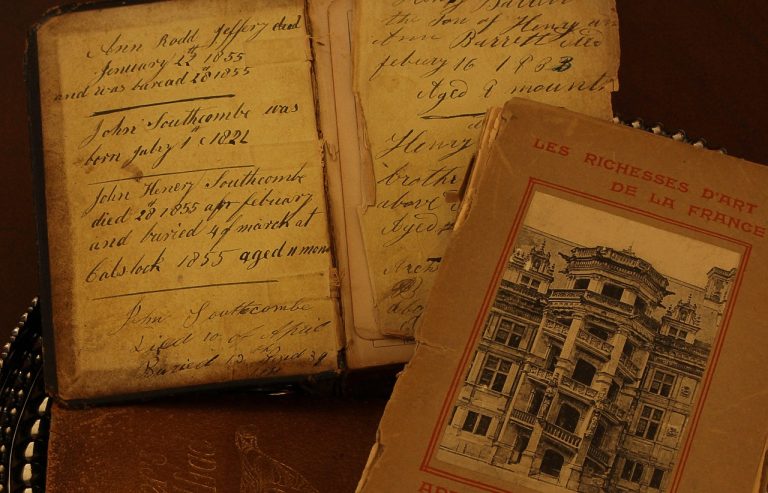
Long before modern digital platforms or formalized genealogical databases, the elders of the Hyman family and the North Harlowe community understood the vital importance of historical memory. They did not just pass down the names of the four founding brothers—Abraham Jr., William, Peter, and Adam—through oral tradition alone. They preserved the legacy through their own community documentation: in family Bibles, homecoming booklets, church anniversary programs, and early parish records.
Listening to these elders and honoring the records they meticulously kept is not just an alternative research method; it is a genealogical necessity. Where the enslaver’s record-keeping failed, the elders’ dedication succeeded, bridging the gap between the 1807 probate file and the physical sanctuary of Hyman Chapel A.M.E. Zion Church. Their self-documented history proves that while the law once quantified these brothers as property, their family always knew them as founders, leaders, and the literal bedrock of North Harlowe.